If you bake, roast, blend or gift-pack for a living, the short answer is this. Buy kernels by style rather than by headline price, ask for the harvest season on the batch, insist on vacuum-packed foil rather than a plain bag, and get every quote in kilograms of the exact grade you will actually use. Most of the money wasted on bulk macadamias in South Africa is spent on wholeness that a food processor destroys in four seconds, or on stock that sat in a warm store room for eleven months before anyone opened it.
We grow, crack and pack our own crop in Mpumalanga, and we quote trade buyers most weeks. So this is written from the supplier side of the table: what to specify, what a fair 2026 number looks like and why, and the questions that quickly reveal whether the person quoting you knows the nuts they are selling.
What counts as bulk, and who buys at each tier
Bulk is not one thing. The volume you order decides which kind of seller can help you, and buyers regularly approach the wrong tier and get quoted badly for it.
| Volume | Typical format | Who buys at this tier |
|---|---|---|
| 5 to 25 kg | 1 kg and 5 kg vacuum bags, cartoned | Cafés, patisseries, small roasteries, farm stalls |
| 25 to 250 kg | 11.34 kg foil pouches in fibreboard cartons | Bakeries, granola and nut butter makers, gift packers |
| 250 kg to 1 ton | Palletised cartons, single style, single batch | Food manufacturers, chocolatiers, private label |
| 1 ton and up | Container lots, kernel or nut-in-shell | Distributors, exporters, industrial processors |
The jump that catches people out is between the second and third rows. At 250 kg of one style from one batch you stop being a customer of a packer and become a small production run. The price drops. So does your flexibility, because you take the batch as it graded.
Buying for year-end client gifts rather than for production is a different brief, with packaging, branding and delivery dates doing most of the work. Our guide to macadamia corporate gifts covers that side.
2026 is a buyer's year, and here is the evidence
Sourcing decisions land better when you know what the season is doing. Three numbers matter this year.
- The local crop is big. SAMAC forecast roughly 93 000 tons for 2026, and some processors put the real figure nearer 100 000 tons, against 87 227 tons in 2024 and 81 139 tons in 2025, according to industry reporting in The Macadamia.
- The world crop is bigger. Global volumes are up about 20% this season, which points to carryover stock going into 2027 rather than any shortage.
- A major export door narrowed.The United States took 31% of South Africa's shelled exports in 2024 and is the main home for halves and pieces, according to the USDA report on our industry. A 30% United States import duty that took effect in August 2025 rearranged the arithmetic for processors selling into it.
Add those up and the local trade buyer is in an unusually strong position this season, especially for halves and pieces. Volume that used to leave the country is looking for a home. If you have been paying the same rate for three seasons, ask again.
Why a local buyer gets quoted an export price
South Africa eats about two percent of what it grows. That one statistic, also from the USDA report, explains nearly every awkward conversation in local macadamia procurement. Your order is not competing with the bakery down the road. It is competing with a container bound for Guangzhou or Rotterdam, priced in dollars.
It also explains why the exchange rate ends up on your invoice. Farm gate nut-in-shell traded around R55 000 a ton this season, with growers putting break-even near R45 000. At the industry conversion of 30% kernel recovery, R55 a kilogram of nut-in-shell is about R183 of raw material inside every kilogram of kernel, before anyone has cracked, dried, sorted, packed or delivered it. That is arithmetic rather than a quote, and I show it for one reason: it tells you where the floor sits. An offer of R120 a kilogram for premium whole kernels should worry you, not delight you. Something in that chain is old, imported, misgraded or not what the label says.
For the shelf-price version of the same picture, our guide to macadamia prices in South Africa breaks down what a retail bag is made of.
Buy the style you will actually use
Kernels are graded by style, and style is the biggest controllable line in your cost. This is the working part of the World Macadamia Organization guide that South African processors quote against.
| Style | Specification | What it is for |
|---|---|---|
| Style 0 | Min 95% whole, over 20 mm | Premium snacking, gifting, plated garnish |
| Style 1 | Min 90% whole, 16 to 20 mm | Retail packs, roasting, chocolate coating |
| Style 2 | Min 50% whole, 13 to 18 mm | Mixed nut packs, bakery topping |
| Style 4L | Min 80% halves, over 13 mm | Biscuits, tarts, granola, ice cream |
| Styles 5 and 6 | Pieces, 8 to 12 mm and 5 to 9 mm | Nut butter, praline, muesli, inclusions |
| Styles 7 and 8 | Pieces 3 to 6 mm, meal under 3 mm | Crusts, dusting, milk, flour blends |
Kernels are also classed premium or commercial. Premium is fully matured and free of significant defects. Commercial allows minor visual defects or slight immaturity. For anything roasted dark, coated, blended or baked into a batter, commercial grade at a lower price is usually the better buy, and no customer will ever know.
The cheapest real saving in bulk macadamia buying is not negotiation. It is dropping two styles for the application that never needed a whole kernel.
The spec sheet to send with your enquiry
Vague enquiries get vague quotes, and then the delivery disappoints everyone. Send these eight lines and you will get numbers you can actually compare across suppliers.
Copy this into your enquiry
- Style and grade. For example: style 4L halves, commercial grade.
- Raw or roasted. If roasted, say salted or unsalted, and light or dark roast.
- Quantity and frequency. A standing monthly 50 kg order prices better than an unpredictable 200 kg.
- Packaging. 1 kg, 5 kg or 11.34 kg pouches, and whether you need vacuum and nitrogen flush.
- Season and batch. Ask for current-season stock and the cracking date, in writing.
- Kernel moisture. The target is about 1.5%. That number is the shelf life.
- Food safety paperwork. HACCP, FSSC 22000 or BRCGS, plus a certificate of analysis if you manufacture.
- Delivery point and lead time. Ambient or cold chain, and who carries the risk in transit.
Packaging and shelf life, in plain numbers
Macadamia kernel is roughly three quarters oil, so packaging here is preservation rather than presentation. The trade standard for export kernel is an 11.34 kg vacuum-sealed multilayer foil pouch, nitrogen flushed, inside a fibreboard carton, and that specification carries a 24 month shelf life while sealed.
Temperature does the rest of the work. Industry handling guidance puts the ceiling at about 12°C for kernel in store, with roughly three months of good life at ordinary room temperature and up to twelve months near 2°C. A South African store room in February is not 12°C. If yours sits in the high twenties, buy smaller and more often rather than chasing a volume break you will lose to rancidity in March.
Two rules we give every trade customer. Decant an opened pouch into sealed containers the same day, because the vacuum is gone the moment you cut it. And smell every batch on arrival: fresh kernel is faintly sweet and buttery, while anything sharp, like old paint or nail polish remover, is rancid and should go back before it is signed for. Our roasting and storage guide runs the same test at kitchen scale.
Kernel or nut-in-shell?
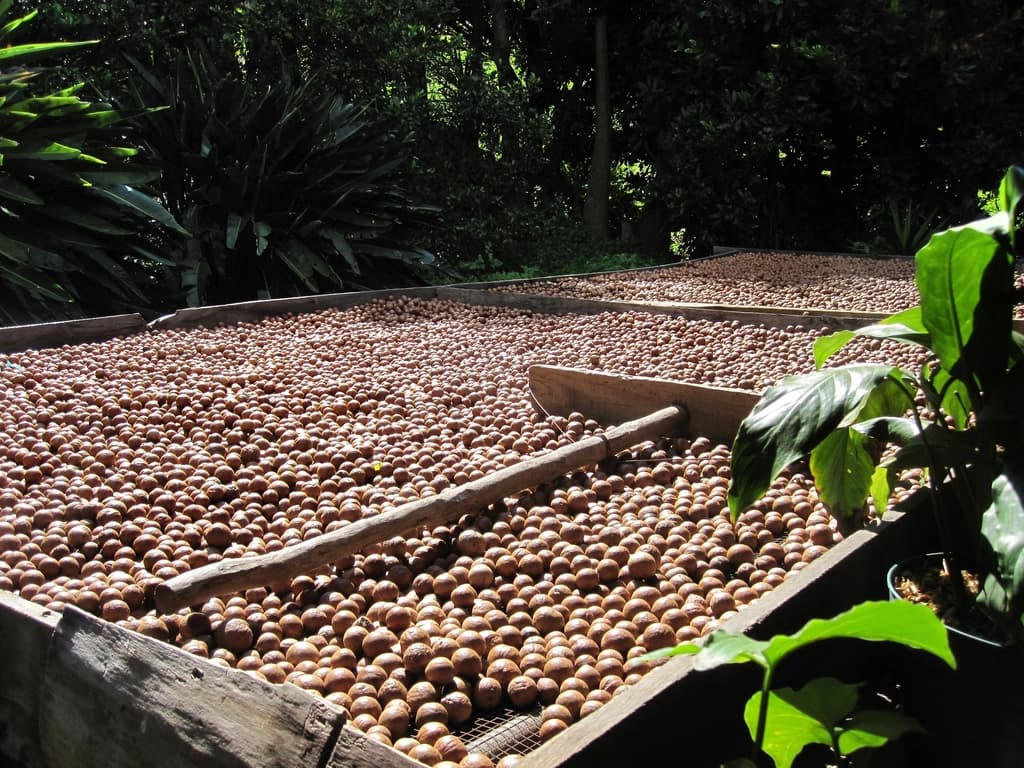
In-shell looks cheaper per kilogram and almost never is. The industry conversion factor is 0.3, so a kilogram of dry nut-in-shell yields about 300 g of kernel. Buy a ton of in-shell and roughly 700 kg of what you paid to transport is shell.
Two good reasons to buy it anyway. It keeps far longer, because the shell is the best packaging a macadamia will ever have. And for farm stalls, markets and gift trade, the cracking ceremony sells the product. If that is your angle, our guide to cracking macadamias without destroying the kernel is the one to hand your customers.
Six questions that separate a grower from a reseller
You do not need a laboratory to grade a supplier. You need these six answers, and how fast they arrive tells you as much as the content does.
- Which season is this batch, and when was it cracked? A grower or processor knows the week. A reseller says recently.
- What is the kernel moisture? Around 1.5%, and they should not have to go and look it up.
- Who cracked it? There are about 29 SAMAC accredited processors in the country, and every batch traces to one of them.
- What was the sound kernel recovery on this lot? Farms and processors know, because they are paid on that figure.
- Can you send 500 g of the actual lot? Not a generic sample. The lot you would ship me.
- What happens if a batch arrives rancid? Settle that before you need it, not after.
How to run a sample properly
Order samples from three suppliers, unlabelled if you can arrange it, and taste them side by side on the same afternoon. You are looking for even cream to ivory colour, a clean snap when a kernel breaks, and a sweet smell with no sharp edge.
Then do the step almost every buyer skips. Put the remainder of each sample in a warm cupboard for three weeks and taste again. Day-one freshness is easy to fake with a good roast. What you are really buying is the shelf life that comes after, and stock that was already six months old when it reached you will show its age in that cupboard long before it shows it on your production line.
Where we fit
We are a family farm in the Mpumalanga heartland that grows, cracks and hand-finishes its own crop, so a batch traces back to our own orchard rows and a specific week of the harvest. We supply raw style 0 kernels, roasted and salted, halves and baking pieces, in-shell nuts and cold-pressed oil, in retail packs and trade volumes.
Tell us the application rather than the product and you will get better advice. A granola producer, a chocolatier and a corporate gift company all ask for macadamias and all need a different style at a different price. Send us your spec, or the eight lines above, and someone who has stood on the sorting line will come back with a quote and an honest recommendation. Sometimes that recommendation is a cheaper grade than the one you asked for.