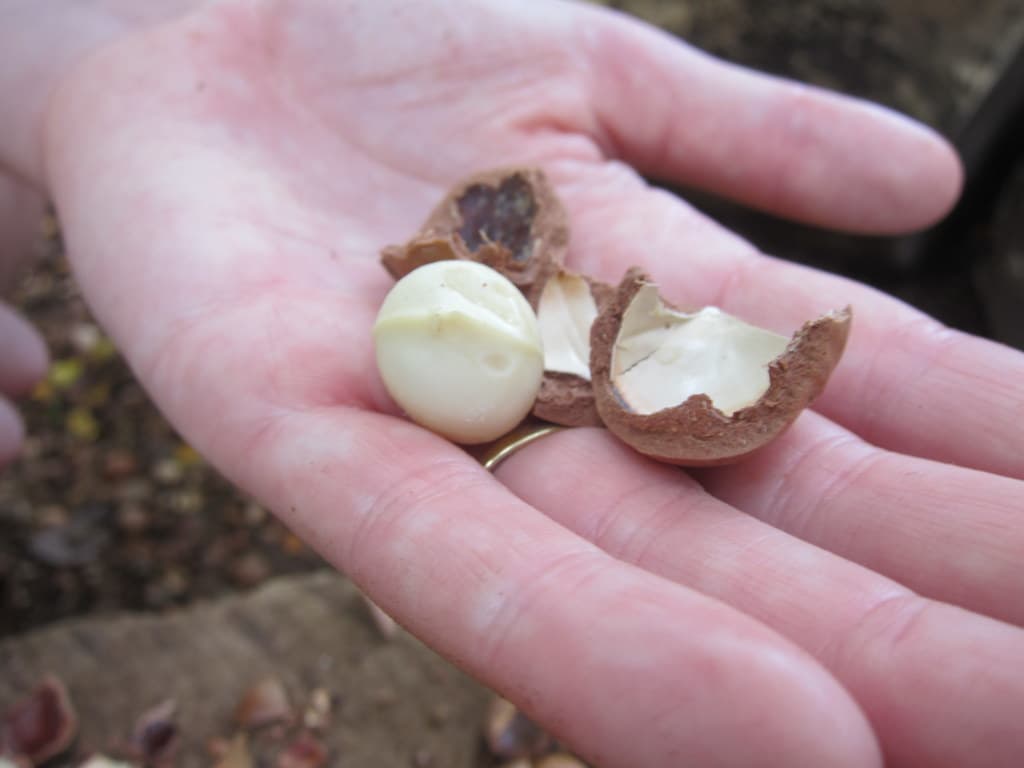
The method, in one paragraph: dry the nuts properly first, sit the macadamia on a hard surface with the seam facing up, find the small pale dot on that seam, and apply slow steady pressure with a purpose-made macadamia cracker or a bench vice. If you are using a hammer, tap the seam squarely rather than swinging at it. Speed shatters kernels. Pressure opens shells.
We crack for a living, at industrial scale and at the kitchen table, and the single most common mistake we see is people attacking the nut with a tool designed for a different nut entirely. Here is why the shell wins, and how to beat it without ending up with gravel.
Why the shell is so difficult
Macadamias have the hardest shell in commercial nut farming. It is not close. Published measurements of the force needed to fracture one range from roughly 2 000 to 4 000 newtons depending on cultivar, moisture and how the nut is loaded, which is several times what a hazelnut or a walnut asks for. The shell is also close to spherical and glassy smooth, so most tools slide off it before they load it properly.
Structure explains the rest. The shell is a dense composite of thick, interlocked fibre layers rather than a simple brittle case, so it absorbs and spreads impact instead of splitting cleanly. That is a brilliant piece of engineering from the tree's point of view. It is why the industry needs specialised cracking machinery, and it is part of what you pay for in a bag of kernels, as we explained in how macadamias are harvested and processed.
The useful consequence: because the shell resists impact but not sustained pressure, a slow squeeze beats a fast hit almost every time.
Step one, which most people skip: are they dry?
A macadamia that fell from the tree last week will not crack nicely, and if it does, the kernel inside is rubbery rather than crisp. The nut needs to dry until the kernel shrinks away from the shell wall. That gap is what lets the kernel come out whole, and it is why commercial drying is the slowest step in the whole process.
At home, spread dehusked nuts in a single layer in a mesh tray or an open crate, somewhere warm, dry and out of direct sun. Two to three weeks is normal. Then use the rattle test: shake one nut next to your ear, and if you hear the kernel knocking about inside, that batch is ready. No rattle means give it another week.
Nuts you bought in a shop have already been dried to about 1.5% kernel moisture, so you can skip straight to the cracking. This section is for anyone with a macadamia tree in the garden, which in the Lowveld is a lot of people.
Find the seam and the white dot
Look closely at the shell and you will see a faint line running around it like an equator. That is the seam, the join in the shell, and it is the weakest line available to you.
On that seam sits a small pale circle, usually a shade lighter than the rest of the shell. Growers call it the micropyle. It is where the shell is thinnest, and the Australian industry body recommends aiming there for exactly that reason. Line your force up on the seam with the dot facing up and the job gets noticeably easier.
The tools, ranked by how well they work
| Tool | How it performs | Watch out for |
|---|---|---|
| Purpose-made macadamia cracker | Best by a distance. A lever or screw cradle holds the nut and applies slow, aimed pressure | Costs more than a kitchen nutcracker, and earns it |
| Bench vice | Excellent. Wrap the nut in a cloth and turn the handle slowly until you hear the crack | Overshoot by half a turn and you have paste |
| Hammer on a hard surface | Works well with practice. Seam up, dot up, firm square taps rather than a big swing | Fingers, flying shell fragments, shattered kernels |
| Locking pliers | Passable for a few nuts. Set the jaws just wider than the nut and squeeze progressively | The nut skids out of smooth jaws |
| Ordinary kitchen nutcracker | Generally fails | Bent nutcracker, intact nut, bruised pride |
Please do not use your teeth. Dentists in macadamia-growing districts have seen the results, and a shell that needs a couple of thousand newtons will win that contest.
The method, step by step
- Check the nuts are dry. Shake one. You want a rattle.
- Turn the nut until you find the seam, then rotate it until the pale dot on the seam faces upwards.
- Set the nut on a hard, stable surface, or in the cradle of a cracker, or between the jaws of a vice wrapped in a cloth.
- Apply pressure slowly and squarely on the seam. With a hammer, use short firm taps and listen for the change in sound when the shell starts to fail.
- Stop the moment it cracks. The shell usually opens into two neat halves, and the kernel lifts out whole.
- Work over a bowl or a cloth. Shell fragments travel further than you expect.
Two things that go wrong
Shattered kernels. Almost always too much speed, or force applied off the seam. Slow down and re-aim. Even commercial crackers accept a proportion of breakage, which is precisely why halves and pieces exist as their own grades and cost less than whole kernels.
Kernels that will not come out. The nut is not dry enough. Put the batch back in the tray for another week or two, and resist the temptation to prise the kernel out with a knife point, which is how people cut themselves.
What a kilogram of in-shell actually gives you
About 300 g of kernel. The conversion factor the industry uses is 0.3, and it holds up well in a home kitchen too. So a kilogram of in-shell nuts at the farm stall is not the bargain it looks like next to a bag of kernels, because roughly two thirds of the weight in your hand is shell you are about to throw away.
What you are buying instead is freshness and time. The shell is very nearly airtight, and macadamia oil goes rancid through contact with air, so in-shell nuts keep for months in a cupboard where loose kernels would have started to fade. Crack them as you eat them and you get the freshest macadamia possible outside of an orchard. The trade-off section in our price guide runs the same comparison in rands.
Do not bin the shells
Macadamia shell is dense, dry and burns hot, which is why processors use it as biomass fuel and why it works well in a braai or a fire pit under proper charcoal. Crushed, it makes a slow-rotting mulch that suppresses weeds around fruit trees and does not blow away in a Highveld wind.
On our farm almost nothing from the harvest goes to landfill, and the husks and shells go back into the orchards and the boilers. At home, a bowl of shells is a small version of the same idea.
Storing the kernels once you have cracked them
Cracking starts a clock. Once the shell is off, the kernel oil meets the air, and warmth speeds everything up. Airtight container, cool dark cupboard, and if the bag is bigger than you will finish in a month, the fridge. We go through the full storage rules, and how to roast the kernels once you have freed them, in our roasting and storage guide.
If you would rather have the ceremony without the drying, our in-shell macadamias come already dried to cracking point and packed with a cracker that fits them, from our own orchards in Mpumalanga. And if you have a tree in the garden and a question about it, ask us. We answer those, and we enjoy them.