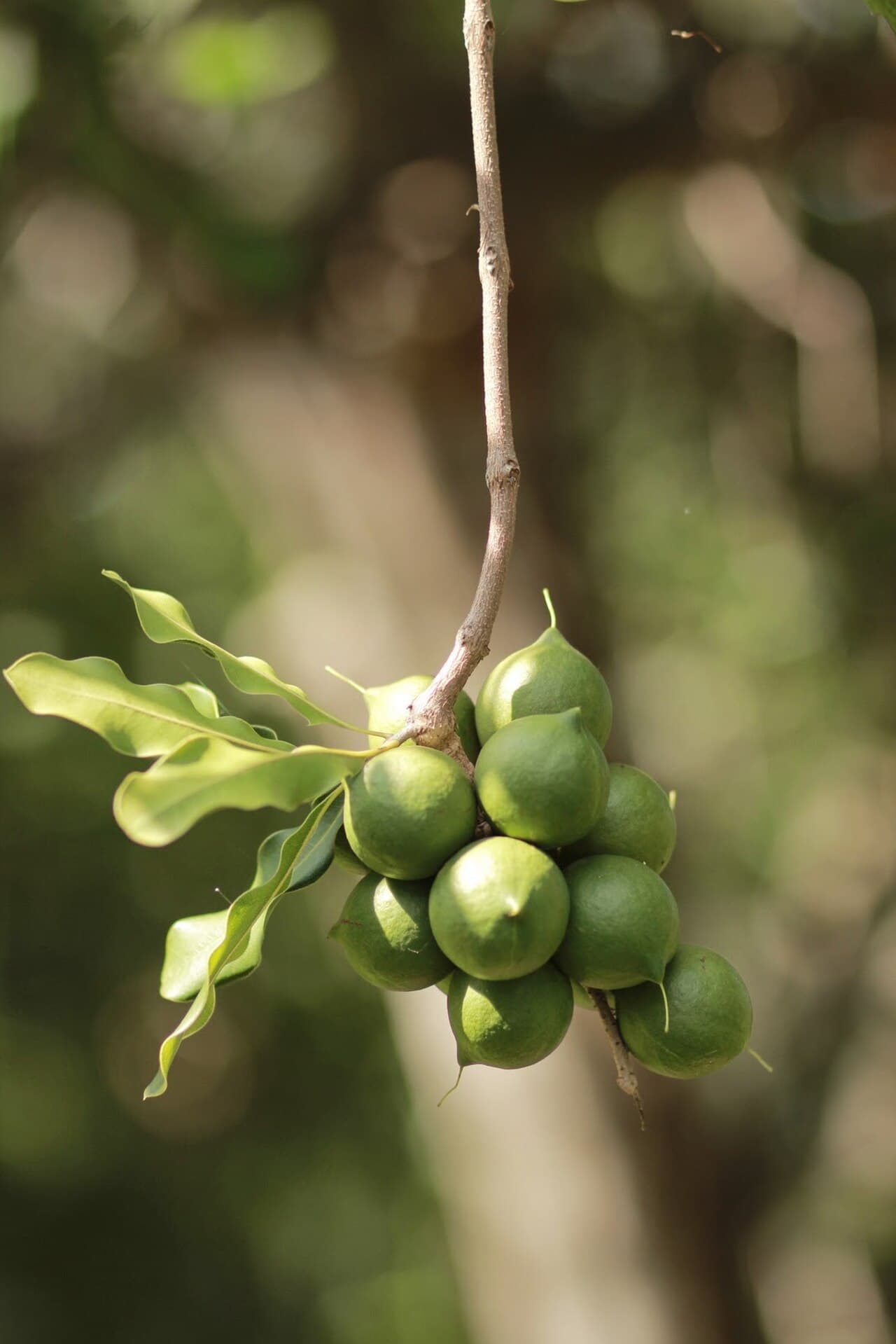
The short answer: a macadamia tree grows well anywhere in South Africa that stays frost-free, which means the Lowveld of Mpumalanga, the subtropical valleys of Limpopo and the KwaZulu-Natal coast. It struggles on the Highveld. Buy a grafted tree from an accredited nursery rather than planting a nut, choose Beaumont if you only have room for one, plant it in spring once the frost risk has passed, and never feed it phosphorus. A grafted tree gives its first nuts in three to five years.
We grow macadamias for a living in Mpumalanga, and a surprising number of the questions we get come from people with one tree in the garden. Most of the advice online is Australian or American, written for different soils, different pests and seasons that run the other way round. This is the South African version, from the people who sweep under the trees every winter.
Will a macadamia grow where you live?
Frost decides it. According to the California Rare Fruit Growers' fruit facts, young macadamia trees can be killed by light frost. A mature tree survives down to about -4°C, but its flower clusters die at around -2°C, and in South Africa the tree flowers in August and September, right when a late cold snap can hit. A tree that survives the winter but loses its flowers gives you a green tree and no nuts.
The commercial industry sits almost entirely in three frost-free areas, which we cover in detail in our guide to macadamia farming in South Africa. For a garden tree, the picture looks like this:
| Area | Winter conditions | Verdict for a garden tree |
|---|---|---|
| Mpumalanga Lowveld (Mbombela, White River, Hazyview, Barberton) | Mild and dry, frost rare outside cold pockets | Ideal. This is orchard country |
| Limpopo (Levubu, Tzaneen, Louis Trichardt) | Mild, frost-free in the valleys | Ideal, with water through the dry season |
| KZN coast and South Coast | Mild and humid | Very good, with wind shelter |
| KZN Midlands, Eastern Cape and Garden Route coasts | Cooler, frost in valley bottoms | Possible on a warm slope, slower to crop |
| Gauteng, Free State and the wider Highveld | Regular hard frost, often well below freezing | Marginal. Grow it as a sheltered garden tree, not a nut crop |
Cold air flows downhill and pools, so a low corner of a Lowveld garden can frost while the rest of the property never does. Plant on the slope or the higher ground if you have the choice.
Which cultivar to buy
Buy a named cultivar, and buy it grafted. Beaumont is the most widely planted macadamia in South Africa, and it is the one we recommend for a single garden tree. It is a hybrid that handles heat and dry spells well, grows upright rather than spreading, and is partly self-fertile. Here is how the common South African cultivars compare, drawing on descriptions from T&T Horticulture, one of the country's largest macadamia nurseries.
| Cultivar | Character | For a garden |
|---|---|---|
| Beaumont (695) | Upright hybrid, suited to dry subtropical areas, large nuts, pink flowers and reddish new leaves | The best single tree. It tends to hold its nuts on the branch, so you pick rather than gather |
| A4 | Spreading, open canopy. Can reach commercial yields in three years | Quick to reward you, but needs width |
| 816 | Upright and moderately dense, with very high kernel recovery and large, even kernels | A good second tree for kernel quality |
| Nelmak 2 | South African hybrid, large nut, high crack-out, pollinates well with Beaumont | The natural partner if you plant a Beaumont |
Beaumont is also the prettiest of the lot in spring, which matters more than people admit when the tree is going in next to the stoep.
One tree will crop, but two different cultivars crop far better. An Australian study published in the Annals of Botany in 2021 found that between 84% and 100% of the nuts on the trees it measured came from cross-pollination, even 200 metres from the nearest block of another cultivar, and that hand-adding cross-pollen raised kernel yields substantially (summarised here by Botany One). Bees do the carrying. If you have space, pair a Beaumont with a Nelmak 2. If you do not, find out whether a neighbour down the road has a tree, because it counts.
Grafted beats seed, every time
Planting a macadamia nut is a lovely project for children and a poor way to get nuts. A seedling takes seven to ten years to bear, and because macadamias cross-pollinate, the seed is not a copy of its parent. You might grow a fine tree with small, thick-shelled nuts, and you will only find out a decade in.
A grafted tree is a known cultivar joined onto a hardy seedling rootstock, so you get the nut you paid for and a first crop years sooner. Commercial nurseries such as Amorentia graft onto Nelmak 2 seedling rootstock and sell grafted trees for around R60 to R72 each at orchard volumes. A single tree from a garden centre costs more. Look for a nursery accredited by the South African Subtropical Growers' Association (SGASA), whose nursery scheme is built around pest-free and disease-free stock. Bringing a borer or a root disease into the garden with a cheap tree is a poor saving.
Planting it properly
Spring is planting season. In the summer-rainfall areas, plant from October as the first rains arrive and the frost risk is behind you, so the tree has a full growing season to settle before its first winter.
Give it room. Without a dwarfing rootstock, a macadamia grows into a tree of 9 to 12 metres tall and 4.5 to 6 metres wide, according to NC State Extension. Keep it well clear of the house, the pool and any paving you care about, because from March to August the ground under it will be covered in nuts, husks and leaves.
Shelter it from wind. The branches are brittle, and a tree loaded with nuts can lose a limb in a strong gust. A spot in the lee of a building or an established hedge is ideal on the KZN coast, where the wind rarely stops.
Planting, step by step
- Choose a sunny, sheltered spot with soil that drains. If water stands in the hole after rain, plant on a raised mound instead.
- Dig a hole about twice the width of the bag and the same depth.
- Mix compost into the soil you took out. Do not add bone meal or superphosphate (see the next section).
- Set the tree at exactly the depth it grew in the bag, with the graft union well above the soil line.
- Backfill, firm the soil gently, and water deeply to settle it and remove air pockets.
- Mulch a circle about a metre across, keeping the mulch a hand's width away from the trunk.
- Stake it loosely against the wind for the first year. A tie that is too tight will cut into the bark.
Feeding without phosphorus
This is where most garden macadamias go wrong. The macadamia belongs to the Proteaceae, the same family as our proteas, pincushions and leucadendrons, and it shares their dislike of phosphorus. Proteaceae evolved on poor soils and grow dense clusters of fine roots that are very efficient at extracting what little phosphorus there is. Research on Macadamia integrifolia shows those cluster roots shut down when phosphorus levels rise. Give the tree a general garden fertiliser heavy in phosphorus and you can do it real harm.
In practice, that means:
- No bone meal, no superphosphate, and no general-purpose 2:3:2 type fertiliser.
- Feed with compost and an organic mulch, topped up each spring.
- If the tree needs a boost, use a low-phosphorus fertiliser of the kind sold for proteas and other indigenous fynbos plants, in small amounts during the growing season.
Yellowing leaves on a young tree are more often a watering or drainage problem than a hunger problem. Check the soil before you reach for the fertiliser bag.
Water through the first dry winters
Macadamias are shallow-rooted, so they feel a dry spell quickly. In the summer-rainfall provinces the critical period is late winter and early spring: the tree flowers and sets nuts in August and September, before the rains have come, and a dry tree drops its young nuts.
For the first two years, water deeply about once a week whenever it has not rained, more often in a hot spell. Once the tree is established it copes with a good deal of drought, Beaumont especially, but a deep watering every week or two from flowering through to the first rains is the difference between a few nuts and a proper harvest. The mulch matters as much as the hose, because it keeps the surface roots cool and stops the soil drying out.
The pests you will meet
Stinkbugs are the most important macadamia pest in South Africa. A 2022 study led by the University of Pretoria found 21 stinkbug species in South African macadamia orchards, with the two-spotted stinkbug, Bathycoelia distincta, thought to be the most damaging. Across the industry they cost roughly US$15 million a year in damaged kernels. They feed through the husk and shell on developing nuts, and the damage shows up as small brown spots or shrivelled patches on the kernel when you crack it.
Commercial orchards monitor and spray on a schedule. In a garden, you are better off accepting some damage than spraying a tree your family eats from. Pick up fallen nuts often, and sort out spotted kernels when you crack them.
You will also meet the macadamia nut borer, a moth whose larvae tunnel into the husk and nut, and plenty of animals that know exactly what a ripe macadamia is worth. Rats, squirrels and, in the Lowveld, vervet monkeys will all help themselves. Gathering nuts every few days is the simplest defence against all of them.
Keep dogs away from fallen nuts
Macadamias are toxic to dogs, and a garden tree drops nuts at nose height for months. According to the Merck Veterinary Manual, dogs have shown signs of poisoning after eating as little as 2.4 g of macadamia per kilogram of body weight. For a 10 kg dog that is about 24 g, roughly eight to ten kernels.
Signs appear within 12 hours: weakness, vomiting, wobbliness, tremors and a raised temperature. The good news is that the poisoning is generally not fatal, and most dogs recover within 12 to 48 hours. Dogs are the only animal in which it has been reported. Even so, call your vet if your dog has eaten macadamias, and treat chocolate-coated macadamias as a double emergency, because the chocolate is toxic in its own right.
A whole nut in its husk is also a hard ball a couple of centimetres across, and that is a choking risk for a dog that bolts its food. If you have dogs, fence off the area under the tree during the drop, or sweep it every day.
Harvest: gather, dehusk, dry
South African macadamias mature from late summer, and the harvest runs from about March to August. Most cultivars drop their ripe nuts to the ground in the green husk. Beaumont tends to hang on to its crop, so you pick those nuts once the husks start to split.
Gather fallen nuts every few days, and daily in wet weather. A nut lying on damp ground starts to go mouldy, or tries to sprout. Then get the husks off within 24 hours. The husk holds heat and moisture around the shell and will taint the kernel if you leave it on. We explain why that deadline matters so much in how macadamias are harvested and processed. At home, the husk peels off by hand once it has started to split, or with a gentle squeeze under your shoe on a hard surface.
Then dry the nuts in their shells. Spread them in a single layer somewhere warm and airy for two to three weeks, until the kernel rattles when you shake the nut. Our guide to cracking macadamia nuts without destroying the kernel picks up exactly where this step ends, and the roasting and storage guide takes it from there.
What a garden tree gives back
A healthy mature tree in good conditions can produce up to 50 kg of nuts in the shell a year, according to Better Homes and Gardens Australia. The industry rule of thumb is that dry nut-in-shell yields about 30% kernel, so 50 kg in the shell gives roughly 15 kg of kernels. That is more macadamias than most families eat in a year, plus a winter's worth of shells for the braai.
It takes patience to get there. Plant a grafted tree this October and you might crack your first nuts in 2029 or 2030, with a proper crop a few years after that. If you would like macadamias in the meantime, our in-shell macadamias come dried and ready to crack, from our orchards in Mpumalanga. And if your tree is doing something odd, send us a photo. We have probably seen it before.